

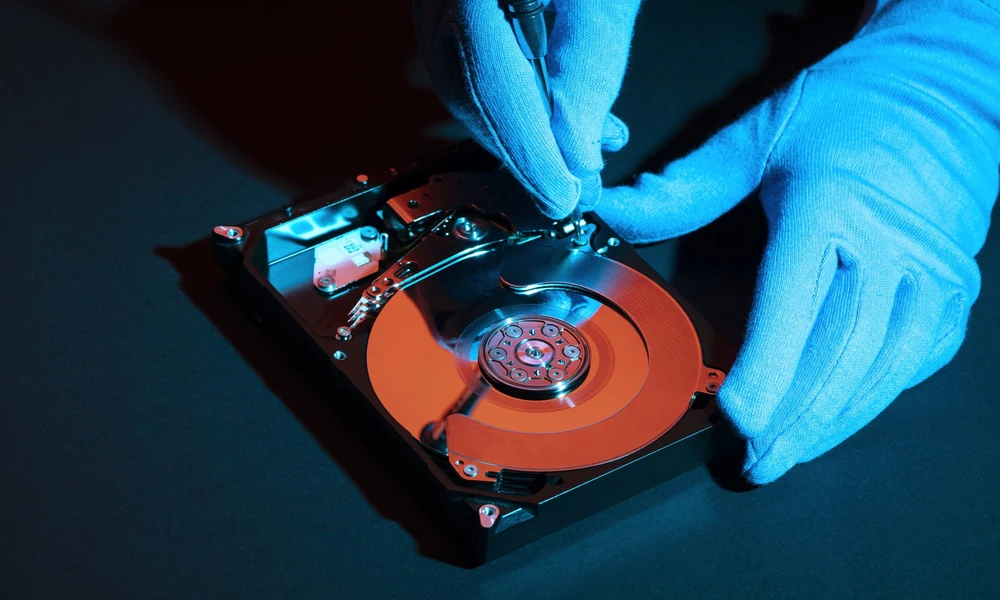
Secure hard disk disposal is one of those requirements that most organisations acknowledge in principle but under-resource in practice. The drives get pulled from decommissioned machines, stored in a box somewhere, and eventually handled informally – donated with the device, sent to a recycler without specific instructions, or simply thrown away. Each of these outcomes creates the same problem: data that was never properly destroyed, on a device that is now outside the organisation’s control.
What Makes Hard Disk Disposal a Security Matter
Hard drives and solid-state drives store data at a physical level that operating system operations do not reach. A standard delete moves the file’s pointer and marks its space as available. The bytes remain. A format wipes the file system structure but leaves the data sectors unchanged. A factory reset on a business laptop runs software that may vary significantly in its thoroughness between manufacturers and device generations.
Against these methods, any recovery tool – from free consumer software to professional forensic platforms – can retrieve intact files. The question is not whether the data is technically recoverable, but who ends up with the device and what they choose to do with it. An organisation that disposes of drives informally cannot answer that question, and under Singapore’s Personal Data Protection Act, that inability to account for the fate of personal data is itself a compliance problem.
The Certified Approach to Hard Disk Destruction
Secure hard disk disposal performed to a professional standard uses methods that defeat recovery at any level. Software-based data wiping to NIST Special Publication 800-88 overwrites every addressable sector of a drive with meaningless values, replacing original data throughout. This method is appropriate for drives being remarketed after treatment, as the physical drive remains intact. Each drive receives an individual destruction certificate recording its serial number, the method applied, and the operator confirmation.
For drives that are non-functional, physically damaged, or subject to a policy requiring physical elimination of the medium, degaussing and hard drive shredding provide assurance at the hardware level. Degaussing uses a powerful magnetic field to randomise the magnetic domains across the entire drive surface. Shredding reduces the drive to metal fragments below the size at which reconstruction is physically possible. Both generate per-device documentation confirming destruction.
Regulatory Requirements in Singapore
The Personal Data Protection Commission enforces Singapore’s PDPA with investigations that have included cases of inadequate disposal. Their guidance is clear: organisations must destroy personal data stored on physical media before that media leaves their custody. The obligation does not transfer to the recycler or reseller. It remains with the organisation until certified destruction is documented.
Organisations can review PDPC advisory guidelines on personal data disposal to confirm current expectations. For organisations in financial services, healthcare, or legal services, sector-specific data governance requirements may impose standards above the PDPA baseline.
As Deputy Prime Minister Heng Swee Keat has noted about accountability in professional practice, “Responsibility cannot be outsourced.” For hard disk disposal, this means the organisation remains responsible for what happens to the data until it has been certified as destroyed – regardless of who does the physical work.
Sectors With the Most at Stake
Every organisation that has handled personal data has a hard disk disposal obligation. Certain sectors face sharper consequences from getting it wrong.
Financial institutions hold customer account data, transaction records, and identification documents that carry both regulatory and commercial sensitivity. Healthcare providers hold patient records that are among the most sensitive categories of personal data. Legal firms carry client confidential information that professional obligations protect beyond the PDPA. Technology companies hold client data, proprietary code, and commercial information that competitors would find valuable. Government agencies and statutory boards are subject to security classifications that require verified destruction methods.
For all of these, certified hard disk destruction is not an optional enhancement – it is the minimum standard their obligations require.
What a Professional Service Delivers
A trusted TD ITAD secure hard disk disposal engagement covers the full process from collection to documentation. Equipment is collected under a chain of custody record. Each drive is individually processed using the appropriate method for its type and condition. A destruction certificate is generated per drive. Equipment residue is routed through NEA-licensed downstream handling for compliant materials processing.
The chain of custody record, collected at each stage, gives the organisation an auditable trail demonstrating that each specific drive was handled correctly. This trail is what distinguishes a genuine compliance outcome from a claim of one.
For organisations that handle personal or commercially sensitive data on their IT equipment, secure hard disk disposal with individual device documentation is the standard that Singapore’s regulatory environment now requires and that good data governance demands.
