

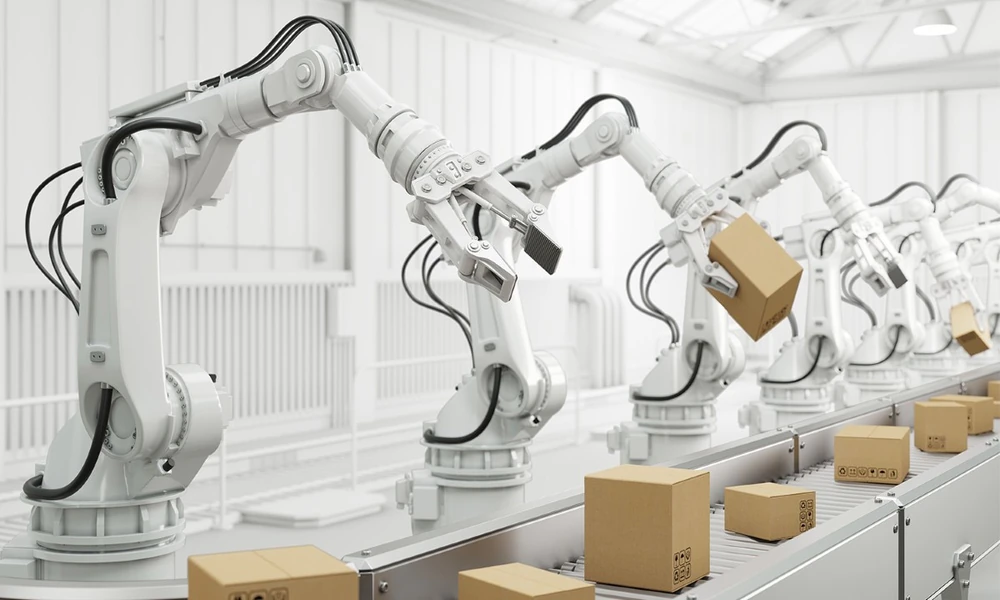
Industrial automation built the modern factory floor on deterministic predictability. For decades, robotic arms excelled whenever an environment remained entirely static. Workpieces arrived at exact coordinates, lighting conditions never flickered, and task sequences followed hardcoded trajectories written in vendor-specific control languages. Any minor deviation-a misaligned tray, a reflective surface variance, or an unfamiliar component geometry-caused immediate system halts.
Recent advancements in artificial intelligence are reshaping this traditional operational baseline. Foundation models, trained on massive multimodal datasets combining vision, language, and tactile dynamics, introduce generalized reasoning to physical machinery. Rather than executing strict conditional scripts, contemporary industrial robots begin to infer intent, compensate for physical discrepancies, and adapt to novel assembly tasks with minimal manual intervention.
Architectural Shift in Robotic Perception and Control
Traditional robotic architectures isolate perception, motion planning, and execution into distinct, modular stacks. A computer vision module identifies a part bounding box, passes 3D coordinates to a path planner, and sends joint vectors to a low-level motor controller. While modular, this pipeline suffers from error propagation. If the vision system fails to account for specular highlights on a machined metallic part, every downstream step breaks.
Foundation models condense these multi-stage pipelines into unified Vision-Language-Action (VLA) architectures. These neural networks process high-dimensional visual feeds alongside semantic instructions, outputting direct end-effector trajectories or motor torque commands. By learning shared representations across spatial geometry and natural language, VLA models eliminate the fragile handshakes between traditional software layers.
Physical execution relies on spatial embeddings that map visual inputs directly to 6-DOF (Degrees of Freedom) action spaces. A robot equipped with a VLA model does not merely recognize a bolt; it understands the orientation required to grasp the bolt, the physical resistance expected during insertion, and the semantic meaning of instructions like “place the fastener into the unoccupied mounting hole.”
Operational Integration in High-Mix Manufacturing Environments
The economic imperative driving this transition is the rise of high-mix, low-volume (HMLV) production. Tooling up an automated cell for a product run that lasts only three weeks was historically cost-prohibitive. Reconfiguring legacy systems required dedicated control engineers, custom mechanical fixtures, and extensive trajectory validation cycles.
Foundation models lower these implementation barriers by enabling zero-shot and few-shot task adaptation. When presented with an unfamiliar component, a generalized model uses pre-trained visual patterns to infer object affordances-identifying handles, structural edges, and fragile surfaces without explicit CAD alignment models.
- Flexible Material Handling: Robots adjust grasp strategies in real time based on deformable materials, varied packaging geometries, or irregular bin arrangements.
- Semantic Quality Inspection: Vision-language models evaluate visual defects based on contextual descriptions rather than rigid pixel-matching masks.
- Natural Interface Programming: Process technicians direct cell behaviors using structured language prompts, bypassing complex ladder logic edits for minor line modifications.
Analyzing broader industry trajectories, particularly the emerging future of robotics trends, reveals a pivot toward systems capable of contextual reasoning rather than fixed routine execution. Operations managers can deploy machinery that absorbs environmental noise, mitigating the downtime previously triggered by minor physical supply chain inconsistencies.
Technical Barriers and Safety Validation Protocols
Despite the advantages of generalized foundation models, deploying nondeterministic neural networks on high-torque industrial machinery introduces engineering challenges. Traditional safety standards (such as ISO 10218 and ISO/TS 15066) depend on verifiable boundary limits and deterministic stop routines. A probabilistic model that generates action vectors presents new verification hurdles.
Inferencing latency presents another technical bottleneck. Large multimodal models containing billions of parameters require significant computational overhead. While standard industrial control loops operate at frequency rates between 500 Hz and 1 kHz, cloud or edge-based foundation model inference often operates at much lower update frequencies.
To reconcile these constraints, system integrators implement hybrid control architectures. High-level motion policies and task sequencing are generated by the foundation model at lower frequencies, while low-level deterministic controllers enforce strict safety envelopes, velocity caps, and collision detection at kilohertz speeds.
Data Efficiency and Sim-to-Real Transfer Dynamics
Training foundation models for physical manipulation requires massive volumes of interaction data. Unlike digital text or static image datasets, physical robot telemetry is expensive, slow, and wear-inducing to collect in real-world facilities.
To overcome this data scarcity, research and development teams rely on physics-informed synthetic environments. High-fidelity simulators generate millions of trajectory trials across randomized lighting, friction coefficients, and surface textures. Domain randomization techniques force the model to learn invariant representations that generalize cleanly when transferred to physical factory floors.
Complementing synthetic generation, fleet learning frameworks aggregate teleoperated demonstration logs across geographically distributed plants. When one facility trains an adaptive model to manage a difficult cable-routing maneuver, the resulting weights update the central model architecture, transferring that physical capability across global production lines.
Strategic Roadmap for Plant Deployment
Transitioning a plant floor toward model-driven automation requires a staged risk-mitigation strategy. Rather than replacing working deterministic cells on high-speed, long-run assembly lines, deployment begins where traditional automation struggles most: manual kitting, unstructured bin-picking, and variable product rework stations.
Initial implementations focus on shadow-mode deployments where the foundation model processes real-time camera streams and suggests motion plans alongside human operators. Once accuracy thresholds, latency profiles, and exception-handling logs meet operational metrics, control is handed over to the automated cell.
As foundation models become more lightweight through model quantization and dedicated edge acceleration, their integration into standard industrial controllers will deepen, moving robotic manipulation from rigid instruction following toward genuine physical autonomy.
